
THE CEO'S ROLE IN THE AI ERA
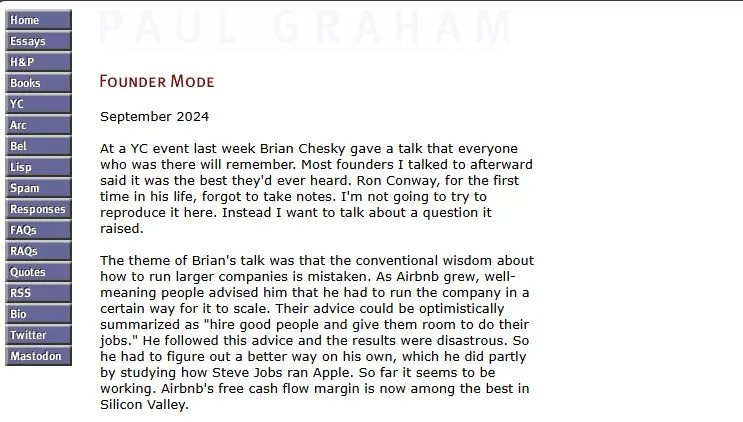
In 2024, Paul Graham wrote an essay that every founder forwarded to someone. "Founder Mode".
The basic argument: conventional wisdom about how to run a company - delegate, hire great people, stay out of their way - was wrong. The BEST founders stayed close. They went deep. They broke the rules because the best founders are obsessed.
It resonated because it was true.
Founder Mode was a permission slip. It told founders that their instinct to stay in the engine room wasn't a character flaw. It was their competitive advantage.
Here's what Paul Graham didn't see coming: AI is about to make Founder Mode obsolete.
The founders who lived in Founder Mode pulled away from the professional managers. Now, the Founders who figure out what comes next will pull away from everyone else including other founders still running on the old model.
The gap is already opening
That next thing is Architect Mode.
Before we get into what this new mode is, you need to understand what it costs you to ignore it.
The founders I work with who are already in Architect Mode are operating at a leverage ratio that looks almost unfair. They're not working harder. They're working on a different layer entirely, designing a system that learns continuously while their competitors are still running from problem to problem.
The gap isn't coming. It's already opening. And unlike most competitive gaps, this one compounds hourly. The world is now digital and you're stuck in analog.
This is not a prediction about five years from now. AI is already collapsing the cost of analysis, drafting, coordination, and execution. Every month, more of what you currently do with people becomes doable with systems. If your org chart looks the same as it did in 2024, you are already behind. And that gap is widening every week.
You built your business on the back of information asymmetry. You knew things your customers didn't. You moved faster than the big guys. You hired smart people and pointed them at problems. It looks like a digital assembly line. That was the game, and you were good at it.
That game is over.
The laptop-lifestyle era, where the right niche and a lean team meant you could print money indefinitely, was built on a window of time that is closing faster than almost anyone in your position is willing to admit.
The question is not whether to change. The question is whether you change before you're forced to shut down.
Three eras of leadership
To understand where we're going, you need to see where we've been.
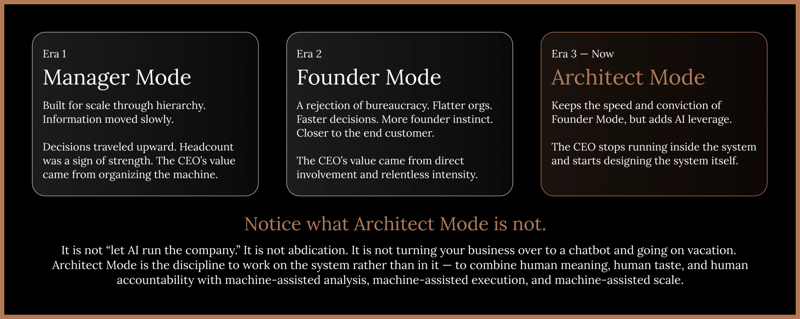
There have been three distinct models of CEO leadership, each one a response to its moment:
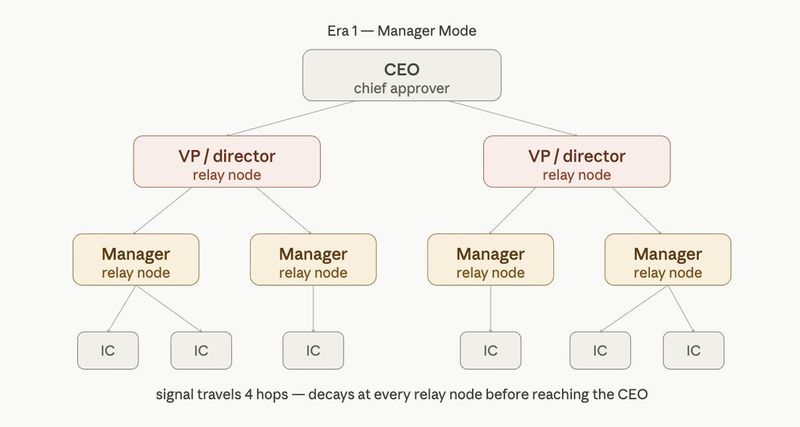
Manager Mode is what most companies still run on.
Information travels upward through relay nodes. A customer insight starts at the IC level, gets compressed by a team lead, reframed by a manager, summarized by a director, and finally reaches the CEO as a filtered version of the original signal. By the time it arrives, three people have already decided what you need to know. The bottleneck is approvals. The cost is speed and accuracy.
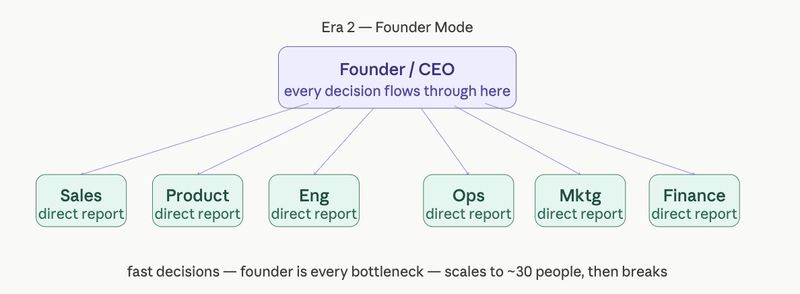
Founder Mode flattened the pyramid. The founder touches everything directly which solved the bureaucracy problem but created a new one. Every decision, every quality check, every direction flows through one person. It scales to about 30 people and then it breaks. The bottleneck isn't bureaucracy anymore. It's you.
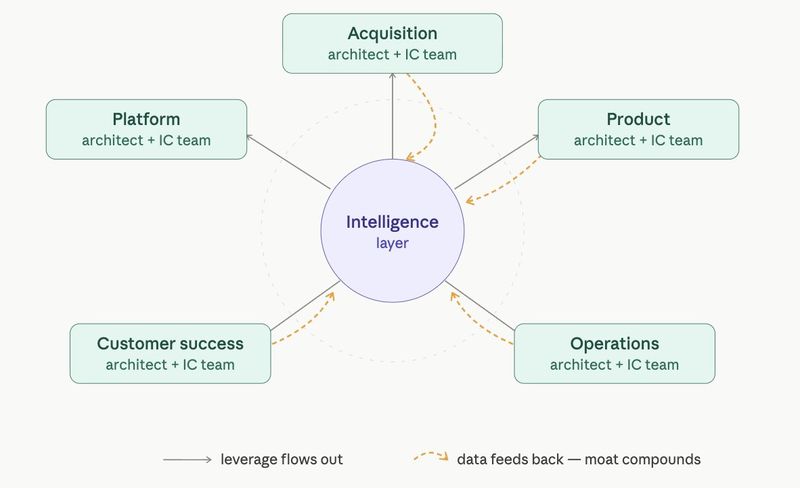
Architect Mode is neither. The intelligence layer sits at the center. Every functional unit connects to it directly. Each unit is self-contained, an architect who owns the system design and assemblers who operate it. The signal from a customer churn event, a rejected submission, a failed sales call goes directly into the center and is reflected back to whoever needs to act on it. No relay. No decay. And every signal that enters makes the system smarter for the next one.
Notice what Architect Mode is not. It is not "let AI run the company." It is the discipline to build the system rather than be the system. To combine Founder vision, Artist taste, Human accountability with AI-assisted analysis, Machine-assisted execution, and System-assisted scale.
What Architect Mode actually looks like
Three examples from companies already running this way:
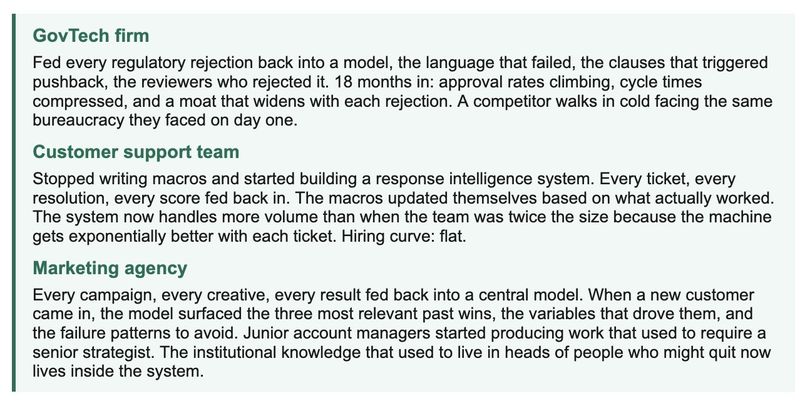
None of these companies built a custom LLM. None of them have an AI research team. They have architects who asked the right question: not "how do we use AI to go faster" but "how do we build a system that gets smarter every time something happens" and then closed that loop.
Sales Leader 2.0
Think about what a sales leader used to have to do. Listen to call recordings on the weekend. Build a spreadsheet of objections. Coach each rep individually. Guess at which scripts were working based on feel and incomplete data (because nobody updates the CRM). Fire the bottom performers six months after the warning signs were obvious, because they never had a clean enough picture to act sooner.
This was the job. Not strategy. Not building. Managing the information gap between what was happening on calls and what leadership actually knew.
In Architect Mode, that job doesn't exist anymore. Every call is transcribed, scored, and analyzed the moment it ends. The system flags what's working, the phrases that correlate with closed deals, the moments where objections get handled well, the sequences that move prospects forward. It updates the scripts automatically. It surfaces the bottom performers not at review time, but in real time, so you don't waste 6 months of wasted leads and missed quota.
The gap between your best rep and your worst rep is no longer a management problem. It's a data problem.
Now the genius lives within the system, instead with the founder or a key executive.
Dorsey Mode?
Jack Dorsey and Brian Halligan (really this is more Halligan's genius) deserve credit for naming what's happening in the enterprise. Dorsey Mode: circular org, continuous planning, hiring for taste, was a genuine evolution and worth studying.
But here's the thing nobody wants to say out loud:
Dorsey is a habitual overhirer who built his credibility for this framework by first creating the problem it solves. Twitter ballooned to 7,500 people before Elon gutted it to under 2,000 and kept the lights on. Block grew from 4,000 employees to over 10,000 during the pandemic, then cut 40% in a single announcement and called it visionary.
He diagnosed a disease he gave himself and is now selling the cure. Give him credit for the cure. Just don't forget who was Patient Zero.
Dorsey Mode is what you do after you've already hired your way into a hole. Architect Mode is what you do so you never dig it.
For seven and eight-figure Founders who never had the luxury of a giant cash reserve to absorb a decade of bloat, the lesson isn't "blow it up and rebuild." It's "build it right the first time": lean, modular, and designed from day one around human judgment with AI leverage.
The org chart you never built is better than the one you have to destroy.
The full comparison:
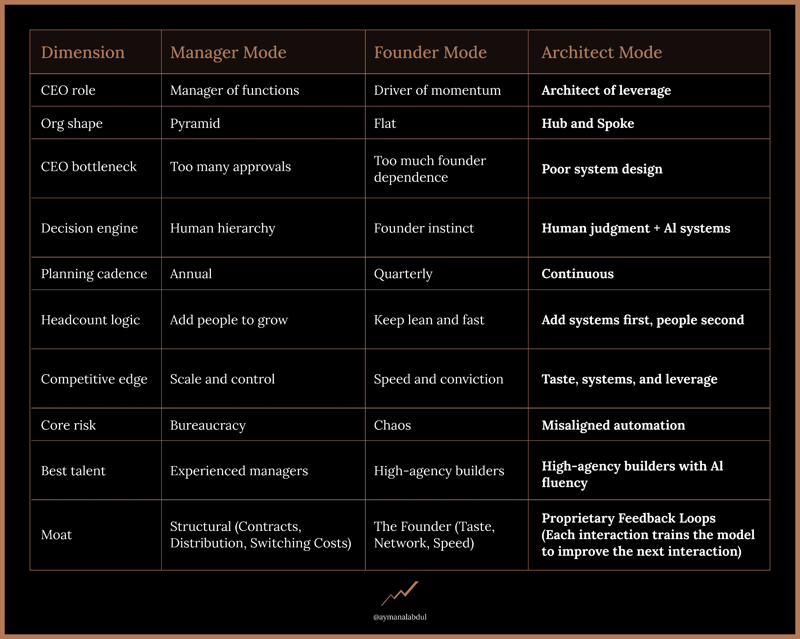
Pay attention to the moat row. That's the litmus test.
Manager Mode moat is on borrowed time, built on contracts and switching costs that erode the moment something better shows up.
Founder Mode moat is mortal: it lives inside one person and retires when they do. (See Adam Neumann and WeWork).
Architect Mode moat is the only one that gets harder to beat the longer you run it. Every customer interaction, every transaction, every query trains the system. The data is the differentiation. This is the only moat that compounds automatically.
You're not just building a better company. You're building a system that gets smarter with each interaction.
The CEO's job in three words
Historically, I've believed there were five things a CEO couldn't delegate:
- Vision
- Culture
- Hiring the exec team
- Resource allocation
- Making sure the company never runs out of cash.
That list is directionally right. But AI now compresses it.
Culture is largely the output of who you hire, what you reward, and what you tolerate. Resource allocation and cash management are really the same job: choosing bets while keeping the company alive. Vision still matters, but AI now does meaningful analytical work that used to sit underneath strategy.
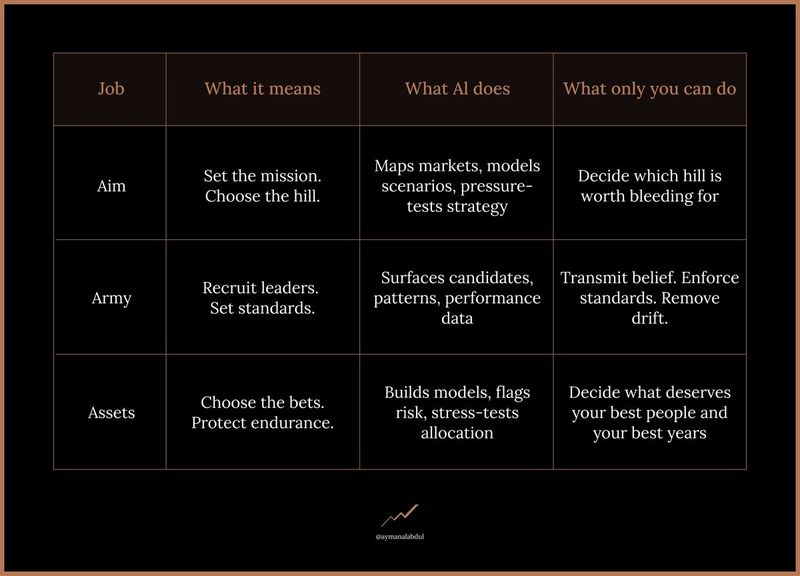
The five responsibilities condense into three:
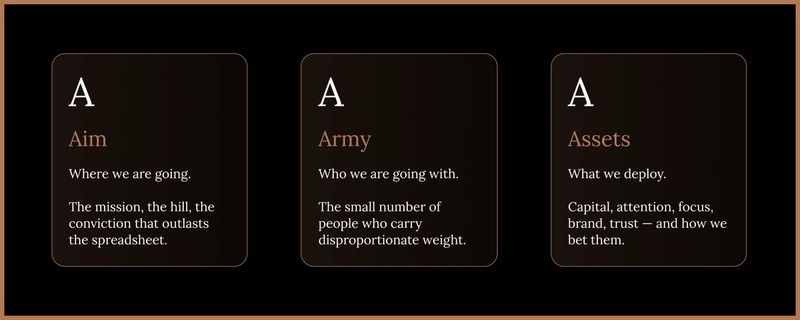
Aim: Where Are We Going?
AI can improve the map. It cannot choose your mountain.
AI can map markets, model scenarios, summarize competitors, identify patterns, and show second-order effects faster than any human team in history.
That matters. Use it aggressively.
But strategy is not the same thing as vision. Vision is not just where the market is going. Vision is where you are willing to go.
“AI can tell you what is rational. It cannot tell you what is meaningful. As intelligence becomes more abundant, conviction becomes more scarce.”
This is why founder-led companies are still pulling away. The difference is not that founders have better spreadsheets. The difference is founder-product fit. The best founders care at a level that professionals cannot fake. They transmit belief. They shape product with intensity. They keep going when the obvious path is to stop.
At AppSumo, the companies that really broke out were often not the prettiest or most polished. They were the ones where the founder was still clearly leading the charge. You could feel it. The customer could feel it too.
The product had a pulse because the founder had one.
Architect Mode does not change that. In fact, it depends on it. AI handles the analysis. The CEO still sets the meaning.
AI is the body and brain. The Founder is the heart.
Army: the talent calculus just changed
The second job is Army, and this is where most founders are about to make an expensive mistake.
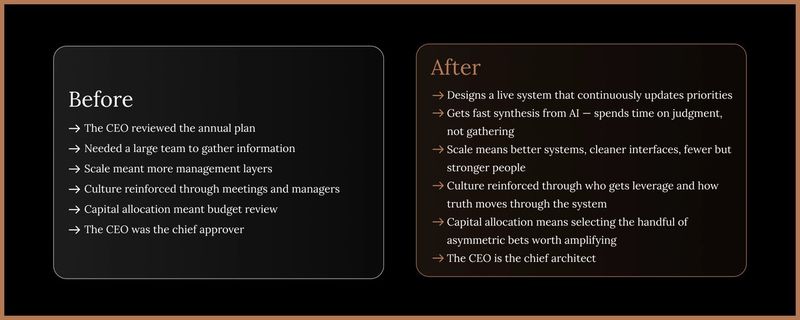
In the old world, you could often solve problems by adding headcount. More managers. More analysts. More coordinators. More layers. In the new world, that is a trap.
One high-agency operator with great taste and strong AI fluency can now outperform entire teams of average performers. You are not just hiring for skill anymore. You are hiring for the multiplier.
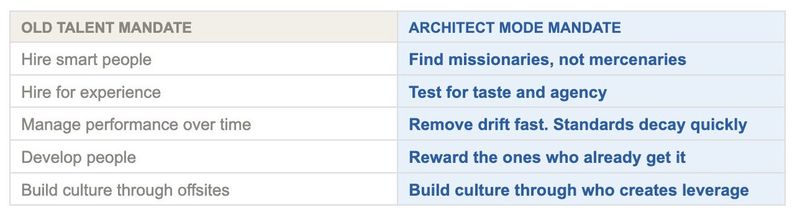
Culture is not a separate CEO responsibility. Culture is the output of Aim plus Army over time.
It is who gets rewarded. Who gets corrected. Who gets fired. And who is building the machine that builds the machine.
Middle managers
Middle management fails in two ways, and both are invisible until you go looking.
The first is hoarding - the manager with 9 direct reports who won't delegate, who's made themselves the bottleneck, whose headcount is their status.
The second is blindness - the manager who doesn't know what's happening two levels down until the CEO finds out first. Both are happening right now in companies that think they have their org under control.
In Architect Mode, the middle manager's job changes completely. They are no longer information routers. They are micro architects. Their job is to take everything happening at the frontline, every customer signal, every friction point, every pattern, and feed it back into the system so the whole organization gets smarter.
The best ones are actively compounding the moat. The worst ones are quietly starving it. The question isn't whether they're a good manager in the old sense. It's whether they're feeding the machine or blocking it.
The new org chart
In Architect Mode, the org chart stops being about reporting lines and starts being about proximity to the machine. There are three layers that matter.
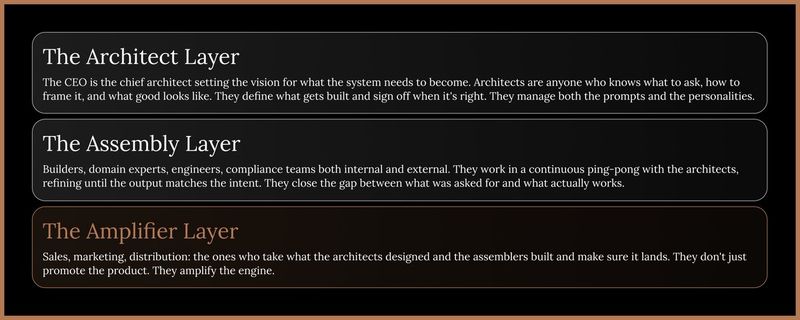
Anyone who doesn't clearly fit one of the three isn't in the new org they're a relic of the old one.
Are you improving or architecting?
Most founders who think they're in Architect Mode are still just improving. The difference is everything.
Improving is running A/B tests on your landing page. Architecting is building a system where every click feeds the model, the model updates the page, every future visitor gets a more personalized experience than the last and none of that requires anyone to touch it. The input of today becomes the output of tomorrow.
This is where the moat actually gets built. Not in the strategy deck. Not in the org chart. In the loop. Every customer interaction that feeds back into your system is a data point your competitor doesn't have. A competitor can copy your product. They cannot copy your loop because your loop is built from your data, your customers, your history. It is the one thing that is structurally yours.
The honest question isn't whether you're using AI. Almost everyone is. The question is whether your AI knows more today than it did yesterday and whether that gap is widening automatically.
If the answer is no, you're not in Architect Mode. You're in Founder Mode with ChatGPT. And Founder Mode, as we established at the top of this article, is no longer enough. (But Aymannn, I'm using Claude. Same difference).
Assets: the scarce resource is no longer information
Assets includes money, yes. But the CEO is allocating more than capital. Time, attention, focus, brand, trust, and organizational calories are all assets. All of them are finite. All of them can be deployed well or wasted.
AI is already excellent at parts of this job. It builds models faster. Stress tests scenarios faster. Flags inefficiency earlier. That means the CEO spends less time doing raw analysis and more time deciding what analysis matters.
The scarce resource is no longer information. It is conviction.
Every company will soon have more dashboards, more options, more strategies, and more machine-generated ideas than they can possibly act on. Most will drown in possibility.
The CEO's new job, the one that cannot be automated, is to decide with conviction: What are we actually doing? What are we not doing? What bet deserves our best people and our best years?
The best CEOs are allowed to be uncertain. They are not allowed to be unclear.
Before and after
Why most CEOs will struggle
Most CEOs will not make this transition because they're optimizing for the wrong thing.
The shift from Founder Mode to Architect Mode is not primarily a technology adoption. It's an identity shift. You have to stop defining your value by your involvement and start defining it by your design.
Founder Mode felt like freedom. Architect Mode requires a different kind of discipline: the discipline to build the thing that runs without you, while staying deeply accountable for what it produces.
Not with better strategy. With better architecture.
The final framework
An architect does not lay every brick. Does not pour every foundation. Does not wire the building personally. But the architect decides what gets built, what holds the structure together, and whether the final thing is coherent.
Aim
Army
Assets
That is now the CEO's job.
Everything else can (and should) be delegated.
I've spent my career at the intersection of where founders get stuck and where they break through. At AppSumo I lived this transition firsthand, scaling from $3M to $84M in annual revenue. Through Agoge I've walked hundreds of seven and eight figure founders through it, driving over $1B in combined growth.
The full playbook, the specific moves, the sequencing, the places where this breaks down and how to fix it is coming soon. Follow along so you can hear about it when it drops.
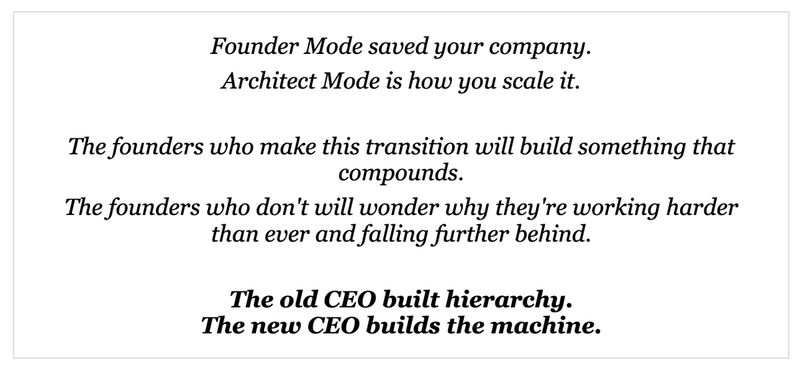
Architect Mode is not the death of the founder. It's the founder fully realized.
The founder who stays in Founder Mode forever eventually becomes the ceiling of their own company. The founder who moves to Architect Mode becomes the architect of something that outlasts their involvement in any single decision. The machine runs. The loops compound. The moat deepens.
The builder didn't die. They've just built something bigger than themselves.
Founder Mode is dead. Long live Founder Mode.